



What Kind of Sand Should You Use Under Pavers?
Choosing sand under pavers requires knowing what role the sand will perform, how the paver system is constructed, what the paver or manufacturer specifies, and what material characteristics the installation actually requires.
Table of Contents
- TL;DR - Choosing Sand for Pavers
- What Does Sand Do Under Pavers?
- Bedding Sand vs. Joint Sand
- Mason Sand Under Pavers
- Concrete Sand Under Pavers
- Mason Sand vs. Concrete Sand Under Pavers
- What Characteristics Matter in Sand Under Pavers?
- Does Sand Go Directly on the Ground Under Pavers?
- How Deep Should Sand Be Under Pavers?
- How Much Sand Do You Need for Pavers?
- Can You Use Mason Sand for Leveling Pavers?
- How to Choose Sand for Your Paver Project
- Frequently Asked Questions About Sand Under Pavers
- Need Sand for Your Paver Project?
Choosing sand under pavers requires knowing what role the sand will perform, how the paver system is constructed, what the paver or manufacturer specifies, and what material characteristics the installation actually requires. The material might be intended as bedding, leveling, joint-related material, or another component of the installation - and the right answer depends on which of these applies.
Product names alone aren't a sufficient specification here. "Sand under pavers" isn't one universal application.
TL;DR - Choosing Sand for Pavers
- There is no single sand that's correct for every paver installation.
- Different sands have different gradations and performance characteristics.
- Bedding sand, joint-related sand, and other materials within a paver system may serve different purposes.
- Mason sand and concrete sand should not automatically be treated as interchangeable.
- Follow the requirements of the paver system, manufacturer, or project specification when one exists.
- Determine the correct sand before calculating depth and quantity.
What Does Sand Do Under Pavers?
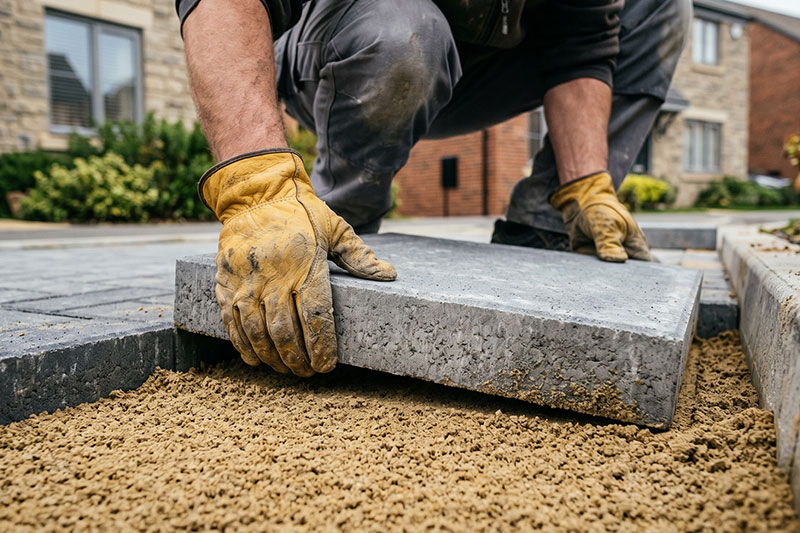
Sand can serve a few different purposes within a hardscape installation: creating a workable bedding or setting layer, helping establish a consistent surface for paver placement, accommodating minor variations within the installation, and other system-specific functions.
It's worth being careful with joint sand here. Material placed between installed pavers is technically part of the paver installation, but it isn't necessarily the same material used underneath the pavers.
Bedding Sand vs. Joint Sand
These two are frequently conflated, but they're distinct:
- Bedding sand is installed beneath pavers as part of the installation system.
- Joint sand is placed between installed pavers.
There's no assumption that the same product should automatically be used for both - they can call for different characteristics depending on the system and installation method.
Mason Sand Under Pavers
Mason sand is relatively fine and workable and may be encountered in certain paver and hardscape applications. That said, mason sand shouldn't automatically be assumed to be the correct bedding material for every paver system - suitability depends on the specific installation. See our guide to what mason sand is and how it's used for more background, or explore Mason Sand if it turns out to be the right fit for your project.
Concrete Sand Under Pavers
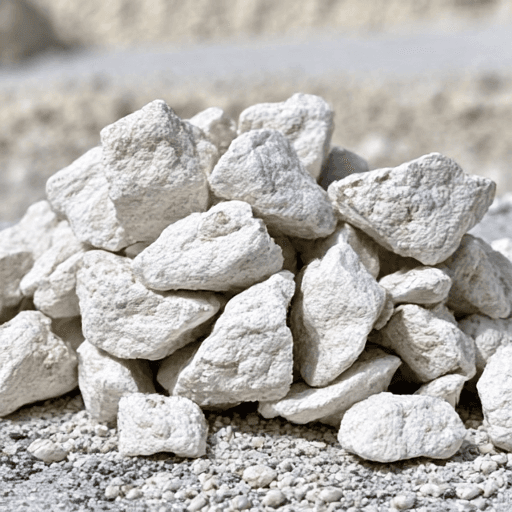
Concrete sand is generally coarser than mason sand and is commonly encountered in certain construction and hardscape applications. Even where certain specifications commonly call for a coarser, graded bedding sand, that isn't a universal rule - the actual installation requirements should determine the material, not the assumption that concrete sand is always correct for paver bedding.
Mason Sand vs. Concrete Sand Under Pavers
At a relative level: mason sand is generally finer and smoother, while concrete sand is generally coarser, with different gradation and working characteristics between the two. Which one suits a given paver system depends on the specification for that system rather than a fixed rule favoring one material.
For a broader comparison beyond paver installations, see our guide to mason sand vs. concrete sand.
What Characteristics Matter in Sand Under Pavers?
Gradation - Particle-size distribution matters to how a sand performs, though specific numerical ranges should come from a verified specification rather than a general assumption.
Fines Content - Finer particles can affect material behavior, but that alone doesn't determine drainage or compaction performance - those depend on the broader system.
Workability - The material needs to function appropriately within the intended installation method.
Drainage Behavior - It's tempting to say "coarse sand drains better," but that's an oversimplification. Drainage depends on the overall system, particle distribution, fines content, compaction, base and subgrade conditions, slope, and surrounding materials.
Project Specification - Where one exists, it should take precedence over generic advice based on a product name.
Does Sand Go Directly on the Ground Under Pavers?
In many paver installations, sand isn't placed directly on unprepared ground. A paver system may involve several prepared layers rather than simply ground, then sand, then pavers. Depending on the project, there may be a prepared subgrade, a base material, a bedding or setting layer, the pavers themselves, and joint material on top. The actual assembly depends on the paver system and installation requirements.
One useful distinction to keep in mind: bedding sand generally shouldn't be confused with the structural or base layer of a paver system. They serve different functions.
How Deep Should Sand Be Under Pavers?
Once you've identified the appropriate sand, the next question is how much of it the installation requires. Sand depth depends on the paver system, the material's role, base preparation, and installation requirements - there's no one-size-fits-all number. See our guide on how deep sand should be under pavers for a closer look at how that's determined.
How Much Sand Do You Need for Pavers?
Once material and depth are settled, quantity is generally calculated from the project area and required depth. See our guide on how much sand you need for the full calculation methodology.
Can You Use Mason Sand for Leveling Pavers?
Sand may be used as part of a bedding or setting layer to help establish a consistent surface for paver placement - but that's different from correcting major grade problems, building significant elevation, replacing required base material, or fixing an improperly prepared subgrade. See our guide on using mason sand for leveling for more on where that material fits and where it doesn't.
How to Choose Sand for Your Paver Project
- Identify the sand's role. Bedding? Setting or leveling? Joint-related application?
- Check project requirements. Manufacturer instructions, installation specifications, and local requirements where applicable.
- Evaluate the required material characteristics. Don't select solely from the product name.
- Determine required depth.
- Calculate quantity.
Frequently Asked Questions About Sand Under Pavers
What kind of sand should you put under pavers?
The appropriate sand depends on the paver system, the sand's role, and installation specifications. Don't assume one sand product is correct for every installation.
Can you use mason sand under pavers?
Mason sand may be used in certain paver or hardscape applications, but it isn't automatically the correct bedding sand for every paver system.
Is concrete sand better than mason sand for pavers?
Not universally. Concrete sand is generally coarser and mason sand generally finer, but suitability depends on the installation requirements and required material characteristics.
Is bedding sand the same as joint sand?
Not necessarily. Bedding sand and joint sand perform different functions within a paver installation and shouldn't automatically be treated as interchangeable materials.
How much sand should be under pavers?
Required depth depends on the paver system, material's role, base preparation, and installation requirements - there's no single number that applies everywhere. See our dedicated guide on sand depth under pavers for more detail.
Need Sand for Your Paver Project?
Confirm the sand type and installation requirements for your paver system before ordering. If mason sand → is appropriate for your project, use our Mason Sand Calculator → to estimate your quantity and explore Mason Sand for bulk delivery to your location.