



Mason Sand vs. Concrete Sand: What's the Difference?
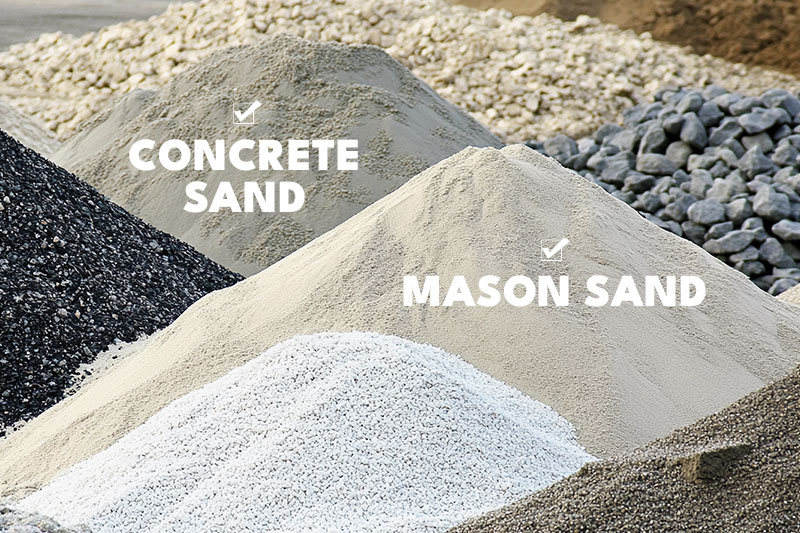
Mason sand and concrete sand are both processed bulk sands, but they generally differ in texture, gradation, and common applications.
Table of Contents
- TL;DR - Mason Sand vs. Concrete Sand
- What Is Mason Sand?
- What Is Concrete Sand?
- Mason Sand vs. Concrete Sand: Key Differences
- Which Sand Is Better for Masonry?
- Mason Sand vs. Concrete Sand for Pavers
- Mason Sand vs. Concrete Sand for Leveling
- Which Sand Is Better for Drainage?
- How Much Sand Do You Need?
- How to Choose Between Mason Sand and Concrete Sand
- Frequently Asked Questions About Mason Sand vs. Concrete Sand
- Need Sand for Your Project?
Mason sand and concrete sand are both processed bulk sands, but they generally differ in texture, gradation, and common applications. Mason sand is generally finer and selected for applications where a smoother, more workable sand is useful, while concrete sand is generally coarser and commonly used where that coarser gradation is appropriate.
Products sold under these names can vary by supplier and region, though, so project specifications should take precedence over generic product labels.
TL;DR - Mason Sand vs. Concrete Sand
- Mason sand is generally finer and smoother than concrete sand.
- Concrete sand is generally coarser and has different gradation characteristics.
- Mason sand is commonly associated with masonry and certain leveling or hardscape applications.
- Concrete sand is commonly used in concrete production and certain construction or hardscape applications.
- Neither material is universally better; the correct choice depends on the application and specifications.
- Don't assume mason sand and concrete sand are interchangeable.
What Is Mason Sand?
Mason sand is a relatively fine, processed sand valued for its workability, commonly associated with masonry work and certain hardscape or leveling applications. As with most bulk sand products, characteristics can vary by supplier and source. See our full guide to mason sand and its common applications for more detail.
What Is Concrete Sand?
Concrete sand is generally a coarser processed sand commonly associated with concrete mixes and other applications that call for its particular gradation and characteristics. As with mason sand, not every product sold as concrete sand automatically meets the requirements of a specific concrete mix or a particular technical standard - that depends on the individual product and its documented specifications.
Mason Sand vs. Concrete Sand: Key Differences
| Characteristic | Mason Sand | Concrete Sand |
|---|---|---|
| General texture | Finer, smoother | Coarser |
| Workability | Generally higher for fine-work applications | Different, coarser working characteristics |
| Common associations | Masonry, certain leveling/hardscape uses | Concrete, certain base/hardscape/construction uses |
| Paver suitability | Depends on application/system | Depends on application/system |
| Leveling suitability | May suit certain fine-leveling applications | May suit other applications depending on requirements |
| Interchangeable? | Not automatically | Not automatically |
These are general, relative characteristics rather than fixed specifications - actual gradation and composition vary by supplier and source.
Which Sand Is Better for Masonry?
Mason sand's name reflects its common association with mortar and masonry applications, where its finer, more workable texture is often useful. That said, the appropriate sand should meet the requirements of the specific mortar mix or masonry application - concrete sand isn't automatically disqualified from every masonry use, and mason sand doesn't automatically meet every mortar specification just because of its name.
Mason Sand vs. Concrete Sand for Pavers
"Sand under pavers" isn't one universal application - sand can play different roles depending on the paver system, including bedding, leveling, and joint-related uses, and the right material depends on bedding requirements, the base system, paver or manufacturer requirements, material gradation, and installation method.
Because this decision depends on more than just which sand type you're comparing, see our dedicated guide on choosing the right sand for pavers for a full walkthrough. And once the sand type is settled, required depth is its own question - it depends on the paver system, the sand's role, base preparation, and installation requirements rather than simply which material you're using. Our guide on determining sand depth under pavers covers that in more detail.
Mason Sand vs. Concrete Sand for Leveling
Mason sand's finer, more workable characteristics can make it useful for certain leveling applications, but material selection ultimately depends on what's being leveled and what performance the project requires. This is distinct from major grading or building substantial elevation, where other bulk materials may be more appropriate. See our guide on using mason sand for leveling for more on where it fits.
Which Sand Is Better for Drainage?
Drainage behavior isn't something you can determine from the product name alone. It depends on particle-size distribution, fines content, compaction, the surrounding soils or materials, the specific application, and overall system design. A coarser material may behave differently from a finer one in some contexts, but that's not a reliable universal rule - the actual material and how it's used both matter more than whether it's labeled "mason" or "concrete" sand.
How Much Sand Do You Need?
Regardless of which material you select, quantity depends primarily on the area being covered and the required depth. See our guide on calculating how much sand you need for the full methodology. If you've already decided mason sand is the right fit, the Mason Sand Calculator can help estimate your project's cubic yards.
How to Choose Between Mason Sand and Concrete Sand
Before ordering, consider:
- What is the sand being used for?
- Is there a required specification?
- Does a manufacturer specify material characteristics?
- Is the sand being used for masonry, bedding, leveling, hardscape, concrete production, or a drainage-related application?
- What gradation or material characteristics does the project require?
- How much material is needed?
Don't choose based solely on which sand is finer, coarser, cheaper, or more readily available. Choose based on what the material actually needs to do.
Frequently Asked Questions About Mason Sand vs. Concrete Sand
Is mason sand finer than concrete sand?
Generally, yes, but actual gradation can vary by product and supplier.
Can you use mason sand instead of concrete sand?
Not automatically. Substitution depends on the application and required material characteristics.
Is mason sand or concrete sand better under pavers?
It depends on the paver system, the role of the sand, and installation requirements. Our dedicated paver-sand guide covers this in more detail.
Which sand is better for leveling?
Mason sand may be useful for certain fine-leveling applications, but suitability depends on the project.
Which sand drains better?
Don't reduce this to the product name alone. Particle distribution, fines content, compaction, surrounding materials, and system design all affect drainage behavior.
Need Sand for Your Project?
Determine which sand best fits your project requirements before ordering. If mason sand is the right material, use the Mason Sand Calculator to estimate your quantity, then explore Mason Sand for bulk delivery to your location.