



How Deep Should Sand Be Under Pavers?
People often look for one number for paver sand depth, but the correct depth depends on how the paver system is designed.
Table of Contents
- TL;DR - Sand Depth Under Pavers
- What Determines Sand Depth Under Pavers?
- What Is the Sand Layer Under Pavers For?
- Bedding Sand vs. Paver Base
- Can the Sand Under Pavers Be Too Deep?
- Can the Sand Layer Be Too Thin?
- Does Sand Depth Depend on the Type of Sand?
- Can You Use Mason Sand Under Pavers?
- How Deep Should Sand Be for Leveling Pavers?
- Does Sand Depth Change After Compaction or Paver Installation?
- How Much Sand Do You Need Once You Know the Depth?
- Before Installing Sand Under Pavers
- Frequently Asked Questions About Sand Depth Under Pavers
- Need Sand for Your Paver Project?
People often look for one number for paver sand depth, but the correct depth depends on how the paver system is designed. The appropriate sand depth under pavers depends on the paver system, the role of the sand, base preparation, material requirements, and installation specifications - there isn't one depth that applies to every paver project.
The general sequence to follow is: choose the correct material, determine the required depth, then calculate quantity. If you haven't settled on a sand type yet, see our guide on what kind of sand to use under pavers before working through depth.
TL;DR - Sand Depth Under Pavers
- There isn't one universal sand depth for every paver installation.
- Required depth depends on the paver system, sand's role, base preparation, and installation requirements.
- Bedding sand is not the same thing as the structural or base layer beneath it.
- More sand is not automatically better.
- Follow manufacturer or project specifications when provided.
- Once the required depth is known, use area x depth to calculate the amount of sand needed.
What Determines Sand Depth Under Pavers?
Paver System - Different systems may specify different bedding-layer requirements.
Role of the Sand - Bedding or setting material is different from base material and joint material, and each may call for a different depth.
Base Preparation - The underlying surface affects how the bedding layer functions.
Sand Characteristics - Material gradation and other characteristics can affect suitability for a given depth or system.
Manufacturer or Project Requirements - Where a specification exists, use it rather than a generic online recommendation.
What Is the Sand Layer Under Pavers For?
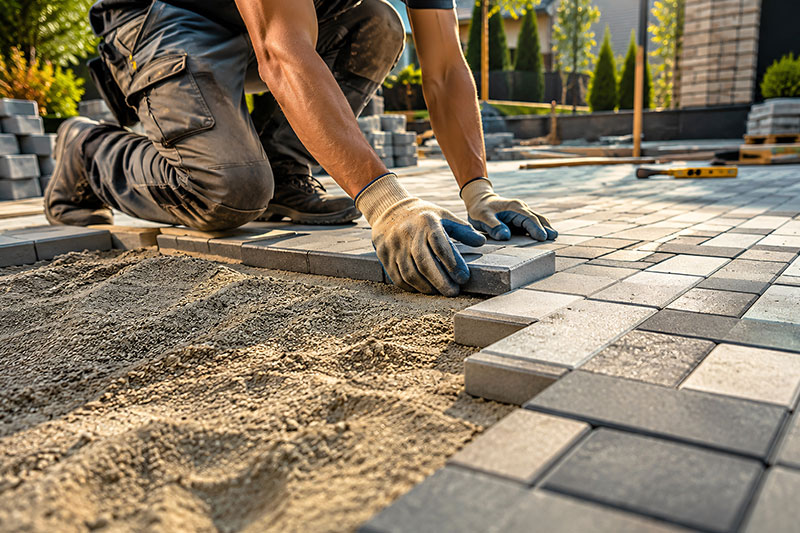
The bedding or setting layer typically helps establish a consistent setting surface, supports placement of the pavers within the designed system, accommodates minor installation variations, and performs other system-specific functions. It generally isn't intended to replace the structural role of the prepared base and subgrade beneath it, where those layers are part of the paver system.
Bedding Sand vs. Paver Base
Many paver systems follow a general sequence like this, conceptually:
This is a conceptual example, not a universal construction specification - actual layer sequences vary by system.
The key takeaway: adding more bedding sand isn't a substitute for properly preparing the base or subgrade. It's tempting to assume that increasing sand depth can compensate for an uneven or inadequate base, but that's not how these systems are generally designed to work.
Can the Sand Under Pavers Be Too Deep?
Yes. More bedding sand isn't automatically better - a layer that's substantially different from the system's intended depth can change how the installation behaves. There's no single maximum depth that applies universally, but deeper sand shouldn't be used to correct major grade differences, replace required base material, compensate for poor subgrade preparation, or build significant elevation. Those issues call for addressing the base and grade directly, not adding more bedding sand on top.
Can the Sand Layer Be Too Thin?
Similarly, less sand isn't automatically better either. Insufficient bedding material relative to what the system requires may prevent the layer from performing as intended or make it harder to establish the required setting surface. As with the maximum depth, there's no universal minimum outside of an actual installation specification.
Does Sand Depth Depend on the Type of Sand?
Indirectly, yes - the installation specification may call for particular material characteristics along with a specific bedding-layer depth or installation condition. There's no universal rule like "mason sand needs X inches and concrete sand needs Y inches." Material and depth are part of the same installation system and should be determined together rather than treated as independent guesses. See our comparison of mason sand vs. concrete sand for more on how the two materials differ.
Can You Use Mason Sand Under Pavers?
Mason sand may be appropriate in certain hardscape applications, but its suitability depends on the paver system and material requirements - it isn't automatically the correct bedding sand for every installation. See our guide to what mason sand is and how it's used for more background on the material itself.
How Deep Should Sand Be for Leveling Pavers?
A bedding or setting layer can help establish a consistent setting surface, but using increasingly deep sand to correct substantial unevenness is a different issue entirely. Major elevation corrections typically call for addressing base preparation, grade, subgrade, or other appropriate materials - not simply adding more sand. Fine adjustment within a setting layer isn't the same thing as major grade correction. See our guide on using mason sand for leveling for more on that distinction.
Does Sand Depth Change After Compaction or Paver Installation?
Loose placement conditions and final installed conditions aren't necessarily identical - but there's no universal conversion like "install X inches loose to get Y inches compacted." Those figures depend on the material, installation system, and specification involved. Where a required depth is specified, it's worth determining whether that figure refers to loose placement, screeded thickness, compacted or final condition, or another defined state, since the same number can mean different things depending on which stage it describes.
How Much Sand Do You Need Once You Know the Depth?
Once depth is established, the calculation is the same as with other bulk sand projects: Length x Width x Depth = Volume. For cubic yards: Length (ft) x Width (ft) x Depth (ft) / 27 = Cubic Yards, or with depth in inches: Length (ft) x Width (ft) x Depth (in.) / 324 = Cubic Yards.
See our guide on how much sand you need for the full methodology. If mason sand has already been selected, the Mason Sand Calculator can handle the conversion for you.
Before Installing Sand Under Pavers
- Confirm the paver system.
- Prepare the subgrade and base as required.
- Determine the appropriate bedding material.
- Confirm the specified sand depth.
- Determine whether that depth refers to a particular installation condition.
- Measure the project area.
- Calculate the required volume.
- Follow the applicable installation requirements.
Frequently Asked Questions About Sand Depth Under Pavers
How many inches of sand should be under pavers?
There isn't one universal number. Required depth depends on the paver system, sand's role, base preparation, and installation requirements. Follow the applicable manufacturer or project specification where one exists.
Can you put too much sand under pavers?
Potentially. More bedding sand isn't automatically better, and excessive depth shouldn't be used as a substitute for proper base or subgrade preparation.
Can you put pavers directly on sand?
Some paver systems incorporate a sand bedding layer, but the complete installation may also require prepared subgrade and base materials. Don't assume that placing sand directly over unprepared ground is appropriate for every project.
Does sand under pavers need to be compacted?
Installation procedures vary by system and material. Follow the applicable installation specification rather than assuming one compaction method applies universally.
How do I calculate how much paver sand I need?
Once the required depth is known, calculate volume from project area x depth and convert the result to cubic yards. See our guide on how much sand you need for the full walkthrough.
Need Sand for Your Paver Project?
Once you've confirmed the appropriate sand and required depth for your paver system, you can calculate the material quantity. If mason sand is appropriate for your project, use our Mason Sand Calculator to estimate your cubic yards and explore Mason Sand for bulk delivery to your location.